How a solar install happens
From bare roof to switch-on
Solar array
Inverter & battery
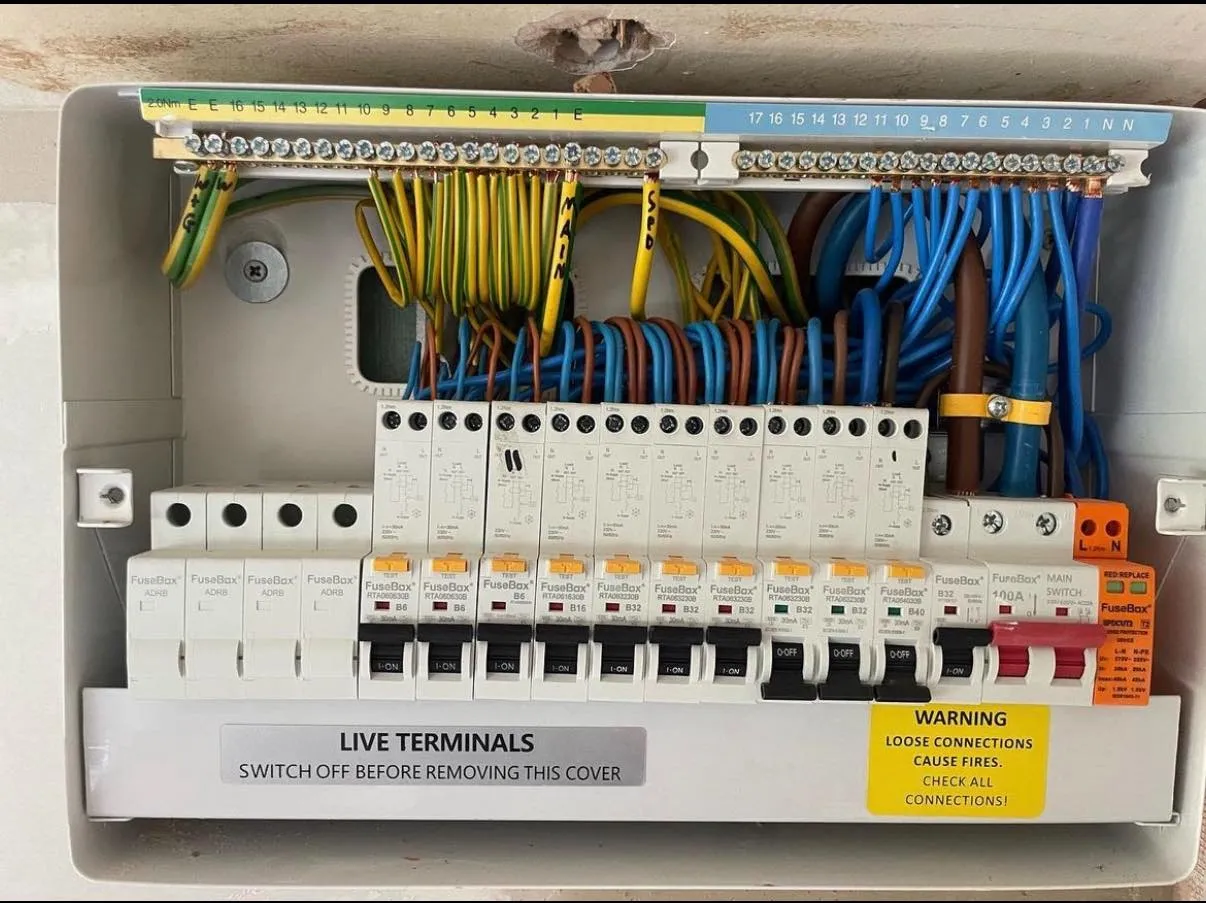
Your fuseboard
Step 1 of 7We look at the roof, the shading, your fuseboard and a recent bill. Then we design the layout and notify your network operator.
Step 2 of 7Our scaffolding goes up. It is part of your quote, not a surprise line on the invoice.
Step 3 of 7Fixings go into the roof structure itself, and the type depends on your roof. Rails go on next.
Step 4 of 7Panels clamp to the rails and get wired into strings. Bird proofing as standard, and optimisers across the whole array if any part of it is shaded.
Step 5 of 7The DC side runs down to the inverter in the garage or utility, with the battery in on the same visit where we can.
Step 6 of 7The inverter feeds back into your fuseboard through its own protected way. Power off briefly while we connect it.
Step 7 of 7Tested, commissioned and switched on. Scaffolding down, certification by email, and we come back if anything needs sorting.
DC from the panels
AC into your board
Battery & bird proofing
After the scaffolding comes down We come back
This is the part people get burned on, and it is the reason to use
a local electrician rather than a national firm.
The big companies subcontract the install to a team that travels.
They fit your panels on the Tuesday, they are three counties away by
the Friday, and when an inverter throws a fault two winters later
you are ringing a number off a leaflet, waiting in for an engineer,
and listening to an argument about whose part has failed.
We fitted it, so we know it. Our team put the panels on your roof,
our records say what went where, and we are twenty minutes up the
road rather than a regional depot. A fault, a niggle, or something
you just want explained again: you ring us and we turn up.
We have 67 five star reviews from people in this county, and we are
not about to start losing them over a job we have already been paid
for.
Herefordshire roofs, and what actually matters
Most of this county is off mains gas. Houses here run on oil, LPG or
electricity, which makes the bills bigger than the national average
and usually moves the solar sums in your favour.
Rural properties tend to have the two things solar likes. Roof space
without a neighbour's gable throwing shade across it, and garages,
barns and outbuildings that can carry panels when the house roof
faces the wrong way. If you work from home, run a workshop or keep a
smallholding, you are using power in the middle of the day, which is
exactly when panels are producing it.
Three things stop a solar job worth knowing about before you spend
anything: heavy shade from mature trees, a roof that will need
recovering in the next few years, and a fuseboard that is not fit to
take the supply. We check all three at the survey and tell you then,
not on install day.
Solar prices
These are guide prices for a straightforward roof, and they include
the scaffolding. Where you land inside a range comes down to the
roof covering, access, and whether the fuseboard needs work first.
The survey is free and your actual quote is fixed and in writing
before anyone starts.
| Job | Price |
|---|
| Roof survey and a straight answer on whether solar pays | free |
| 3kW system, around 8 panels, supplied and installed | £5,000 to £6,500 |
| 4kW system, around 10 panels (the common size) | £6,000 to £8,000 |
| 5kW system, around 13 panels | £7,000 to £9,500 |
| 6kW system, around 16 panels | £8,000 to £11,000 |
| Battery storage added to any of the above | £3,000 to £5,000 |
| Commercial and agricultural roofs | priced on request |
0% VAT until 31 March 2027
Solar and battery storage fitted at a home are zero rated for VAT
until 31 March 2027. There is no VAT to add to your quote at all,
and that is the full 20% gone rather than a discount we are
offering you. From 1 April 2027 it goes to 5%.
A battery counts on its own too, so you can put the panels on this
year and add storage later without losing the relief. Commercial and
agricultural roofs are standard rated in the normal way.
Your written quote states the exact total before any work starts.
Scaffolding, a fuseboard that needs upgrading first, or an awkward
roof will change the figure, and we tell you at survey stage rather
than on the invoice.